
Citizen Science
Mussel Sampling and Testing
Overview
A study undertaken in 2007 to sample and analyze the sediments off the mill ponds in Fort Bragg, California, published in 2008 (link), included in the original proposal, collection and analysis of benthic organisms, but these samples were not taken due to inclement weather.
Project-HERE identified this as a significant data gap and engaged in citizen science, using grant funds obtained through the Department of Toxic Substances Control (DTSC) Technical Assistance Grant program.
Three sites were selected for mussel (Mytilus californianus) collection, to test for dioxins, furans, and PCBs. Two sites were located in Soldier Bay, adjacent to the abandoned mill ponds, while a third site was established north of Fort Bragg as a reference. Two sampling events occurred at each site: one set in early October, 2025, and the second set in late February, 2026.
The habitat type targeted for sampling was the lower rocky intertidal zone in areas of high wave action, which is often inhabited by Mytilus californianus, a sentinel species for indication of marine contaminants.
Across all three sites, most individual dioxin/furan congeners were not detected (ND) or were present at very low estimated levels. However, several dioxin-like PCBs and PCBs congeners were detected, with the highest concentrations detected at Soldier Bay North and Soldier Bay South, when compared to the reference site.
DISCLAIMER: This report provides preliminary data that should prompt discussion of what further sampling or research, if any, might be needed. There is not sufficient information to draw any definitive conclusions.
Sampling Locations
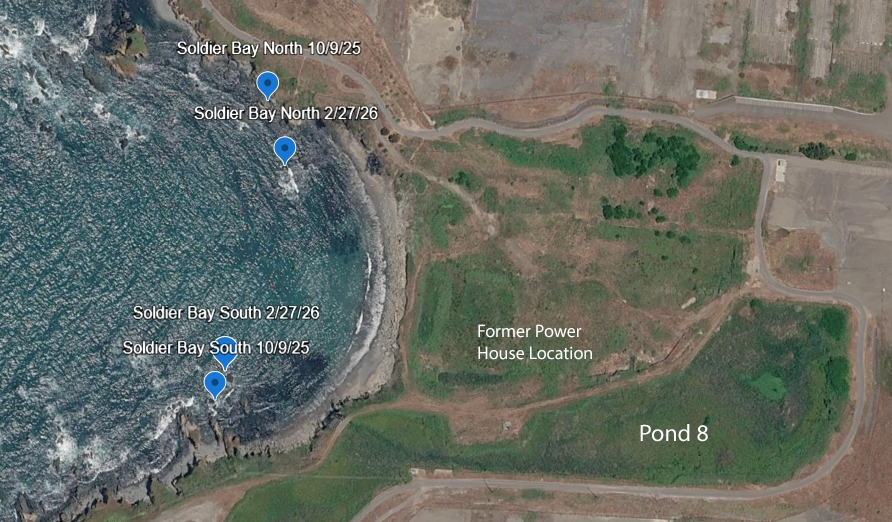
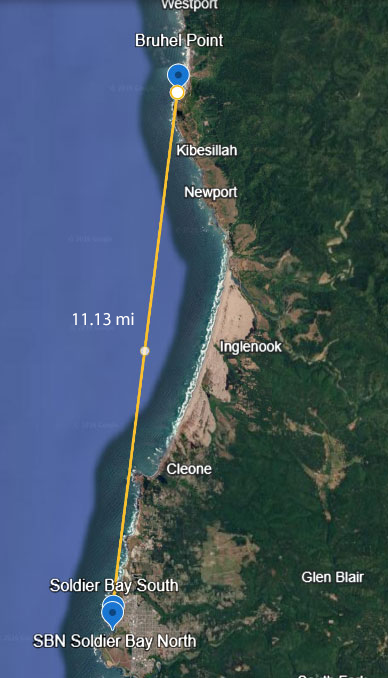
Mussel Mytilus californianus test samples were taken from the locations shown in Soldier Bay, on the north and south sides of the OU-E beach and Pond 8 dam structures. Reference samples were taken on the day before each set of test samples, from Bruhel Point, approximately 11.3 miles north of Soldier Bay. A detailed description of the sampling procedure and sample preparation may be found here.
Sampling Methodology Summary
- Three sites in Mendocino county, CA were selected for mussel collection to test for dioxins, furans, and PCBs. Two sites were located in Soldier Bay, near Fort Bragg, California, while the third site was located at Bruhel Point, approximately 12.5 miles (~20km) north of Fort Bragg. Two sampling events occurred at each site: one set October 8-9, 2025, and the second set on February 26-27, 2026. Both sampling events took place within two (2) days of the lowest low tide of each month. The habitat type targeted for sampling was the lower rocky intertidal zone in areas of high wave action, which is often inhabited by Mytilus californianus, a sentinel species for indication of marine contaminants. Collection was conducted under CDFW Scientific Collecting Permit and took place outside of any state or national parks, MPAs, or areas with other protections in place.
- Mussels collected in October, 2025 were dissected to remove the hepatopancreatic organ. The frozen dissected tissue from the three sites were sent to Enthalpy Analytical, El Dorado Hills, CA for analysis.
- Mussels collected in February, 2026 were frozen whole and sent to Cape Fear Analytical, Wilmington, NC for analysis.
- A detailed description of the sampling methodology can be found here: Mussel Sampling Collection, Preparation and Delivery to Testing Laboratories
Analytes: PCBs, Dioxins, Furans, and Dioxin-like PCBs
- Dioxins and furans are toxic, persistent environmental pollutants, created primarily as byproducts of industrial processes and combustion, such as waste incineration or degradation of electric transformers. Dioxin-like PCBs are a subset of PCBs that share a similar planar structure and toxicological mechanism with dioxins (PCDDs/PCDFs). Dioxins, furans and dioxin-like PCBs do not break down easily in the environment and accumulate in fat, resulting in higher concentrations up the food chain.
- Polychlorinated biphenyls (PCBs) are a group of 209 man-made, toxic organic chemicals, ranging from oily liquids to waxy solids, that were widely used as coolants, lubricants, and insulation in electrical equipment between 1930 until 1979 when they were banned in the United States. PCBs were designed to be chemically stable (persistent organic pollutants-POPs), and that stability is exactly what makes them difficult to degrade (strong chemical structure, resistance to natural degradation, poor solubility in water, bioaccumulation).
Results and Findings Summary
Overall Findings
Across all three sites, most individual dioxin/furan congeners were not detected (ND) or were present at very low estimated levels. However, several dioxin-like PCBs and PCBs congeners were detected, with the highest concentrations detected at Soldier Bay North and Soldier Bay South, when compared to Bruhel Point.
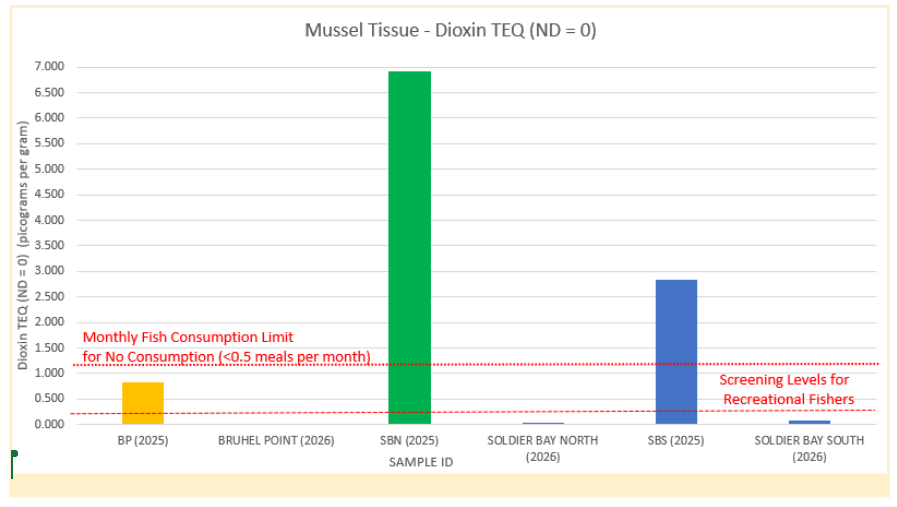
Summary of Mussel Tissue Analytical Data for Dioxin/Furan and Dioxin-like PCBs used in TEQ Calculation
Bruhel Point
- Most dioxins and dioxin-like PCBs were non-detect or at lower concentrations when compared to Soldier Bay North and Soldier Bay South.
- Example: PCB-105 detected at 3.74 pg/g (2025 Sample) and 6.26 pg/g (2026 Sample) at Bruhel Point.
Soldier Bay North
- Higher concentrations of dioxins and dioxin-like PCBs when compared to Bruhel Point.
- Example: PCB-105 detected at 21.4 pg/g (2025 Sample) and 45.6 pg/g (2026 Sample).
Soldier Bay South
- Highest concentrations of dioxins and dioxin-like PCBs among all three sites.
- Example: PCB-105 detected at 12.5 pg/g (2025 Sample) and 59.2 pg/g (2026 Sample).
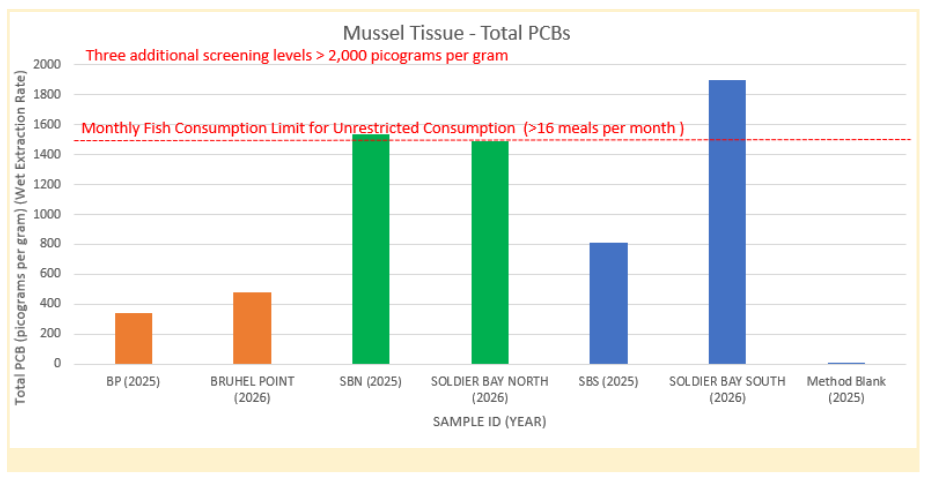
Summary of Mussel Tissue Analytical Data for PCB Congeners
Bruhel Point
- Bruhel Point shows lower PCB concentrations, when compared to Soldier Bay North and Soldier Bay South.
- Total PCBs: 343 pg/g (2025 sample) and 476 pg/g (2026 sample).
Soldier Bay North
- Soldier Bay North had the highest PCB concentrations overall in 2025. Total PCB concentrations were four times greater when compared to Bruhel Point.
- Total PCBs: 1540 pg/g (2025) and 1490 pg/g (2026).
Soldier Bay South
- Soldier Bay South had the highest PCB concentrations overall in 2026. Total PCB concentrations were four times greater when compared to Bruhel Point.
- Total PCBs: 810 pg/g (2025) and 1900 pg/g (2026).
DISCLAIMER: This report provides preliminary data that should prompt discussion of what further sampling or research, if any, might be needed. There is not sufficient information to draw any definitive conclusions.
Detail Documents, Laboratory Results and Analysis
- Mussel Sampling Soldier Bay – Fact Sheet - This Citizen Science web page (without the maps) in printable format.
- Mussel Sampling Collection, Preparation and Delivery to Testing Laboratories - Detailed narrative of the sampling, dissection of the October samples, delivery and temperature tracking of the samples to their respective laboratories.
- Table 1 - Mussel Tissue Analytical Results for Dioxins and Furans - Spreadsheet of analytical results for all three sites for showing Toxic Equivalency Quotients (TEQ) for eight dioxin/furan groups and significant constituent dioxins/furans and dioxin-like polychlorinated biphenyls (PCBs)
- Table 2 - Mussel Tissue Analytical Results for PCBs - Spreadsheet showing analytical results for 209 polychlorinated biphenyls (PCBs), including total PCB screening and consumption levels
- Enthalpy Analytical Laboratory Results Report for October Soldier Bay and Bruhel Point mussel samples
- Cape Fear Analytical Laboratory Results Report for February Soldier Ban and Bruhel Point mussel samples

